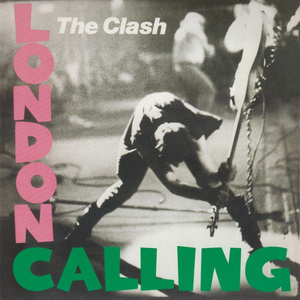
The Clash - London Calling
This album features what was named by Q magazine as "the best rock and roll photograph of all time, capturing the ultimate rock'n'roll moment - total loss of control". Indeed, the black and white image has become an iconic symbol of the punk rock movement as well as heightening the legacy of the band, in many ways demonstrating the way an album image can supersede the album in terms of brand/band recognition. Interestingly, the composition of the title is an intertextual reference to Elvis Presley's debut eponymous album (which was also inspiration for Tom Waits' Rain Dogs LP cover, and several others), which is perhaps meant to infer the new and exciting musical direction the band had taken with 'London Calling'.Album Art Analysis 1
Jamie T - Panic Prevention
The actual album artwork of the real artist of our song is a messy and chaotic composition, giving the mise-en-scene a montage feel despite being a single photograph. A lot of the content is ambiguous, although it gives the appearance of being carefully constructed to give a representation of the artist. The content (indiscernible polariods, band posters, empty beer cans and ashtrays, musical equipment and a self-referential poster of the artist himself as well as a physical copy of the LP with the same artwork) give an impression of independent musical taste which not only reflects on the myriad of genres covered during the album, but also the broad musical tastes of the target audience. The colours in the photo are desaturated, combining with the disorganised iconography to emphasise the working class lyrical themes explored. The title text is positioned at the very top of the artwork, in a small font and faded white colour,which draws attention away from the name of the artist/album and instead forcing the viewer to explore the photograph for meaning. This could represent the artist's desire for his audience to ignore meaningless image-focused pop-genre way of looking at music, and instead to focus on subjective interpretation and artistic depth. This is also demonstrated through the fact that although the cover art features the artist, he is slumped at a low angle at the bottom corner of the artwork, hiding behind a guitar and a drab, monochromatic costume. The viewer is only able to see a little of his face in a very unconventional shot of the "star" - even he is staring at the scene created in front of him.
Digipak Conventions
Functionally, digipaks exist to protect the CD and carry institutional information (eg label copyrighting, barcode, denoting writing/recording credit, reference number etc) as well as to advertise the contents, standing out to attract suitable members of the target audience when browsing shelves/digital stores. This means that the digipak's artistic design must reflect the creative intentions of the artist, as well as targeting the specific genre's audience through recognisable generic conventions. (See my other posts analysing how specific album covers achieve this.) The album art must not only represent the band, their image, their audience and the genre of music, but also imply institutional factors, such as what kind of label it is released on, the appeal of the band as an underground artist and whether it is a first release or not. However, as well as conforming to the conventions of the genre, the digipak must also be unique, eyecatching and interesting, or else its potential as a promotional tool would be wasted.
Digipaks are also noted for their considerably reduced environmental impact compared to traditional jewel-cases. This is an attraction for smaller, more ethically-minded record labels or bands with such attitudes, although is not considered an important factor by profit-driven major labels.
This research will influence my digipak as I now understand the importance of particular features in the design and implementation of artwork - not just for the front/album cover, but for the entire digipak product.
Digipaks are also noted for their considerably reduced environmental impact compared to traditional jewel-cases. This is an attraction for smaller, more ethically-minded record labels or bands with such attitudes, although is not considered an important factor by profit-driven major labels.
This research will influence my digipak as I now understand the importance of particular features in the design and implementation of artwork - not just for the front/album cover, but for the entire digipak product.
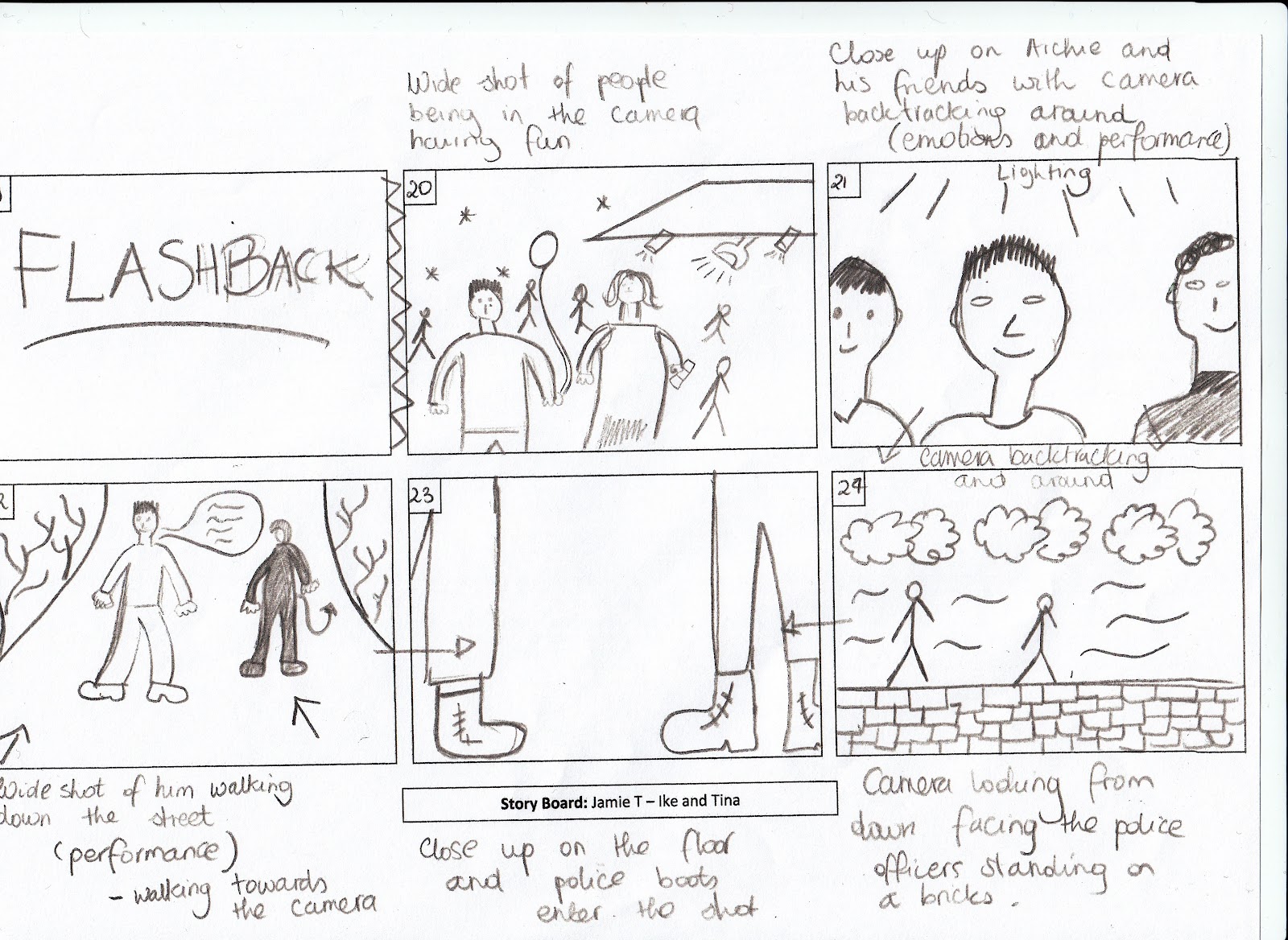
Storyboard
![]() |
| Story Board - Page 1 |
![]() |
| Story Board - Page 2 |
![]() |
| Story Board - Page 3 |
![]() |
| Story Board - Page 4 |
![]() |
| Story Board - Page 5 |
![]() |
| Story Board - Page 6 |
![]() |
| Story Board - Page 7 |
![]() |
| Story Board - Page 8 |
Also, after our previous experiences filming the sequences last year, I would not be surprised if our final ideas become developed during filming/editing to such a point that the finalised product is almost unrecognisable to this initial storyboard.
Full Pitch
Treatment ► Link→
Explanation: The key theme of our music video will be a sense of sobering regret towards adolescent hedonism, and a desire to mature. This moral decision will be signified by the change in his attitudes in the lyrics and in our video, with children as policemen highlighting the debate of age and maturity which comes across in the lyrics.
However, the specific narrative will be fragmented to the cusp of ambiguity. The clinic's letter itself will not be specified, instead allowing the audience to draw their own conclusions of what it says from the actor's reaction (drawing from the ending of one of my favourite music videos, Radiohead's 'Just' [link]). Similarly, there will be no literal explanation of the policemen, which in turn portrays them as "metaphorical" characters, ie representing an idea rather than an actual person. The chasing scene will also show desirability of the artist, as well as his desire to 'escape' his lifestyle.
I think that the reasons behind our idea will give it critical depth, while the use of chaotic flashbacks, contrasting locations and clashing timelines will provide fun, sustained interest, ambiguity, fragmented disorientation and narrative enigma to what could otherwise be a dull video.
Casting ► Link→
Locations ► Link→
Explanation: The key theme of our music video will be a sense of sobering regret towards adolescent hedonism, and a desire to mature. This moral decision will be signified by the change in his attitudes in the lyrics and in our video, with children as policemen highlighting the debate of age and maturity which comes across in the lyrics.
However, the specific narrative will be fragmented to the cusp of ambiguity. The clinic's letter itself will not be specified, instead allowing the audience to draw their own conclusions of what it says from the actor's reaction (drawing from the ending of one of my favourite music videos, Radiohead's 'Just' [link]). Similarly, there will be no literal explanation of the policemen, which in turn portrays them as "metaphorical" characters, ie representing an idea rather than an actual person. The chasing scene will also show desirability of the artist, as well as his desire to 'escape' his lifestyle.
I think that the reasons behind our idea will give it critical depth, while the use of chaotic flashbacks, contrasting locations and clashing timelines will provide fun, sustained interest, ambiguity, fragmented disorientation and narrative enigma to what could otherwise be a dull video.
Casting ► Link→
Locations ► Link→
Treatment
The music video will begin with our artist walking out of a sexual health clinic with an STD test result. He drops it, and walks off. The music starts and the key narrative begins, which is our artist waking up disheveled after a particularly indulgent night out, and stumbling home while performing the song lyrics. This will be interspersed with fragmented, chaotic flashbacks to moments the night before at the party, and kept interesting by changing between locations for the performance. There will also be a two children dressed as policemen chasing the artist. The flashbacks will include a sex scene (linking to the clinic at the beginning), and the video will end in a circular structure to bookend the video and give it a sense of conclusion.
Diary/Schedule
I am maintaining a shooting/editing schedule on the main blog, which as time goes is becoming more of a diary of our progress: http://freddyandtheletdowns.blogspot.co.uk/2012/01/13-filming-schedule-and-diary-update.html
It provides a satisfying timeline of the project, although the slow progress highlights much of the delay which has plagued our work.
Artist Image Research (Star Image)
The following are some of the most interesting images of the artist we are creating a video for. Jamie T's visual style is interesting in its extraordinary representation of normality. Existing just on the edge of popular fashion for young males, without conforming to any particular 'scene', it demonstrates the characteristics of the disenfranchised youth of the 21st century, drawing from a variety of influences such as skinhead, punk, street and indie wear.
From fashion and photography to music videos, live shows and album artwork, this visual style (including those of other similarly 'ordinary' artists) will be the key inspiration informing our own decisions in creating the image of our own artist.
I think that it forms a perfect relationship with the style of music, described in a magazine as "the bastard lovechild of Billy Bragg and Mike Skinner doing his best Joe Strummer impression" - simultaneously unique and instantly recognisable.
Investigating the marketing of new music
The traditional process of marketing a band's new release can cost PR companies working for major record labels an extremely large amount of money, as the merit and potential profit to be gleamed from an artist's new album will go to waste if it does not gain enough exposure to its target market/audience. Press coverage (in suitable genre magazines or newspapers), radio airplay (again, on appropriately genre-focused radio stations) and advertisements on television, radio and posters can all help promote awareness of the new LP. At the time of writing this, the clearest example of a successful marketing campaign of a major artist is for Paul Weller's newest release, 'Sonik Kicks' (Island Records/UMG), which has permeated through print, poster, radio and television adverts as well as reviews in national newspapers to wide public awareness.
However, that procedure of promotion has been changed dramatically in the internet age. Professional websites and social media involvement, as well as digital distribution services such as iTunes, Bandcamp, Soundcloud, Myspace and Facebook mean that music has become incredibly accessible. Thus advertising has begun favouring digital (eg banner adverts on Vevo channels) rather than print mechanisms, and focusing on fan interaction whilst keeping traditional promotional methods (such as posters and radio commercials) as a secondary, low-key factor, particularly if the label is unwilling to pay for a large scale campaign.
Through digital means, the promotion of new music in the online world has become increasingly cheap and easy, such as viral campaigns, spreading through the word of mouth social network. The most famous example of this is OK GO's (a band much celebrated for their ingenious music videos) treadmill video for 'Here It Goes Again', which propelled the band to fame through a simple low-budget video uploaded to YouTube. This demonstrated how home made videos can propel small acts to worldwide fame without the wide scale, corporate-led marketing procedure.
However, for non-mainstream acts, the problem is not protecting their product from piracy, but the predicament of obscurity. Whereas some bands turn to excessive touring to get their name 'out there' in a very physical way, free social media (such as Facebook) can be used to connect with the target audience, songs can be provided for free (through websites like Bandcamp), and thanks to the reduction of costs in hardware and software needed for filming a music video (promoted/released on YouTube), it is now possible for a song to reach fame without spending very much at all.
Subscribe to:
Posts (Atom)